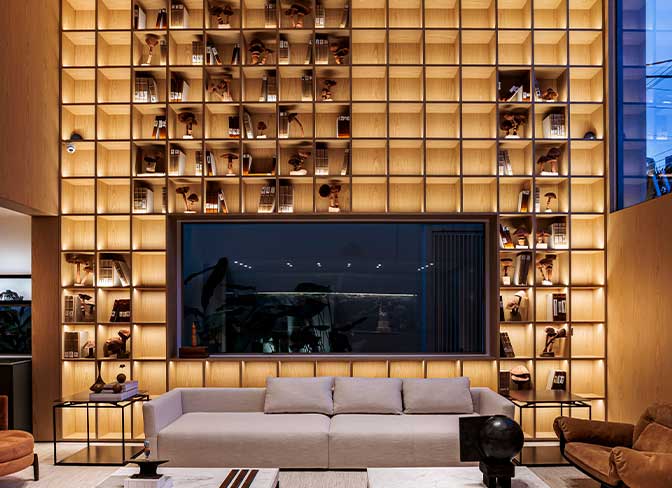
It is not always easy to explain why an environment seems so well-resolved. Often, this perception comes from the sum of decisions that make the whole function precisely: proportions, fits, openings, internal organization, and constructive solutions that rarely attract attention in isolation.
It is common to associate quality with what appears first, such as materials, colors, and finishes. But there is an important part of the project that is built before the surface and directly influences the way the furniture looks and functions.
At Evviva, this attention begins with the way the building itself is constructed.
Precision begins before finishing
O Persona System It allows the furniture to be developed piece by piece, with special shapes and measurements adapted to the specificities of each environment. This logic expands the freedom of creation and allows the project to respond more precisely to the architecture, the proportions of the space, and the intention of the designer.
A well-thought-out measure avoids unnecessary compensations. An appropriate proportion helps the furniture integrate into the space. And the possibility of working on each piece individually paves the way for compositions designed for that context.
The technique then becomes part of the project’s own language.
What supports a clean design
Part of this language depends on elements that almost never appear.
In the Stima Collection, for example, doors aligned with the panels, the absence of apparent frames, and hidden hardware help create more continuous surfaces and a cleaner visual reading.
The same principle appears in other points of the Evviva furniture, such as hidden supports for shelves and fittings chosen to integrate discreetly into the furniture.
They are technical solutions that almost disappear in the overall design, but directly interfere with the perception of the project. By hiding a support, the shelf gains continuity. By integrating hardware, the design becomes cleaner. By aligning a door with the panel, the surface now functions as part of a single composition.
Quality is also in what remains discreet
A well-executed project doesn’t need to explain every choice so that care is perceived. Often, it appears precisely in the absence of noise; it fits, works, and integrates into the overall design without apparent effort.
With the Persona System, this precision begins with the construction of each component. In Stima, it can be seen in the way doors, panels, and fittings integrate with the interior architecture.
They are different paths, but they all converge on the same principle: allowing technique to work in favor of drawing.
At Evviva, constructive intelligence is present from the conception of the furniture to the elements that remain almost invisible after installation. It is this coherence between design, technique, and use that forms part of the quality of a project.
Visit the Evviva website and discover solutions that reveal the constructive intelligence present in every detail.