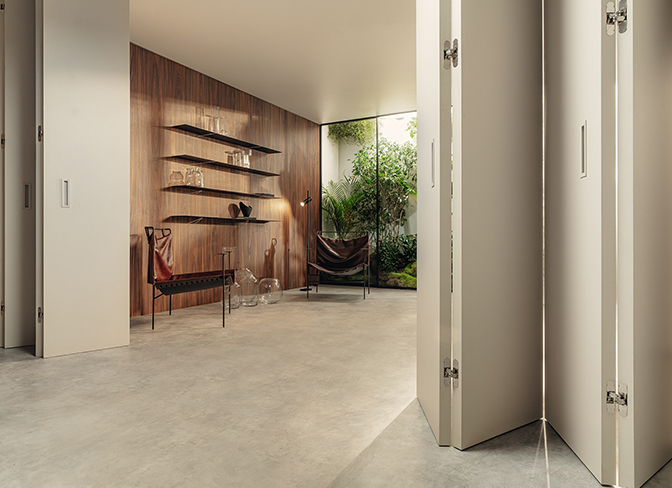
Well-executed projects rarely draw attention for a single element. They stand out for the sense of order, clarity, and balance that remains even when the space is in use, with people moving around, doors opening, and routines taking place.
This perception doesn't come from the decoration. It comes from the decisions made during the project's design phase.

When architecture guides the use of space
The way spaces connect, separate, or overlap directly influences the experience of those who live there. Doors, passageways, and panels are not just functional solutions; they organize flows, guide movement, and define how the space is perceived throughout the day.
When these choices are made consciously, the result is a space that remains coherent even in different usage scenarios. It functions without requiring adaptation effort.
Invisible decisions that make a difference
Many of the most important choices in a project are not immediately visible. They are in the way a door blends into the wall, how a transition happens without interrupting the gaze, or how an environment closes off without breaking the reading of the whole.
These details build a sense of calm and organization that doesn't depend on styles or trends. They rely on precision and intention.
Estimate the role of continuous architecture
A Stima emerges to accompany this type of project. It was designed to blend discreetly into the architecture, preserving the reading of the space and contributing to clearer and well-organized solutions.
By acting almost imperceptibly, Stima reinforces architectural decisions and helps maintain project consistency over time, without competing with other elements.
Projects that work in real-world use
A well-executed project doesn't need to be explained. It reveals itself in everyday experience, ease of use, and a sense of balance that remains even when the house is in motion.
When architecture, design, and construction decisions go hand in hand, the space stops being just beautiful. It becomes functional, clear, and comfortable for those who live there.