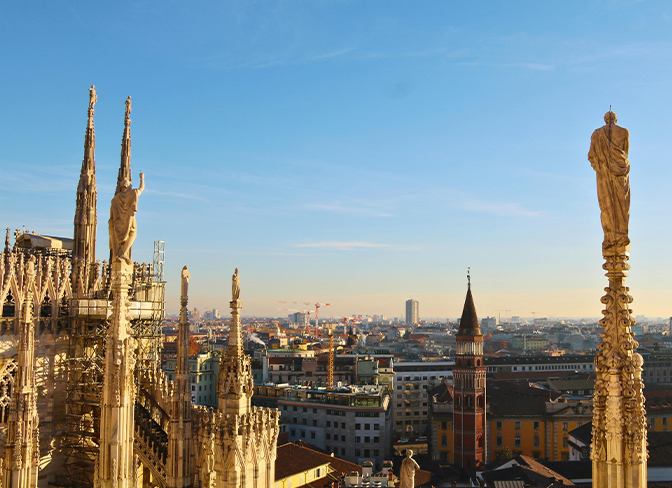
There are cities that host events. Milan, in April, seems to reorganize its own time around them.
During the Milano Design Week, design ceases to occupy only specific places and begins to permeate the city. It is present in the pavilions, but also in the streets, in historic buildings, in shop windows, and in everyday routes. In a few days, everything becomes an observation point.
The Salone del Mobile concentrates the industry's strength, with solutions that indicate sector movements, while the Fuorisalone spreads experimentation through districts like Brera, where design mixes with art, fashion, and behavior.
But perhaps the most interesting thing is not what is presented, but rather the kind of perception that this set evokes.
A city that doesn't separate creation and life
In Milan, design isn't isolated. It coexists with architecture, with the city's memory, and with the way people occupy spaces.
This overlap creates a continuous reading, in which past, present, and future projections coexist. And it is in this interval that relevant questions arise for those who project.
They aren't always immediate answers, but shifts in perspective that, over time, transform how we think about a space.
Design as a silent radar
Between one installation and another, between a revisited material and an almost invisible technology, something less evident, but essential, is being formed: a sensitivity.
It's as if design functions as a radar for transformations in living, capturing signals that aren't fully defined yet but are already altering behaviors and expectations.
Not everything translates into a trend. Not everything needs to. But a shift is happening, and it often appears first where creation meets freedom.
What is the project about
For those who develop solutions, this experience is not limited to observation. It subtly permeates the process.
Not as a direct reference, but as a repertoire that influences choices — in how to work a material, organize a space, or take a less obvious path.
Innovation doesn't appear as an isolated goal. It is built from these layers, almost as a consequence of a broader perspective.
Between what passes and what remains
In Milan, there's always an abundance of stimuli, ideas, and possibilities that reveal themselves in different layers throughout the city.
Some of this is lost to time, as is natural in any intense movement. But there is also that which remains in a more subtle, almost silent way, and which finds space in how people live, use, and relate to their environments.
It's not always what grabs your attention at first glance. Often, it's what makes sense in use, in permanence, in continuity. And it is precisely there that experience stops being mere inspiration and begins to translate into more conscious choices.
It's worth following this gaze closely because it's from there that the future ways of living are born.